SYNTHESIZERS
Corona
Discovery
Discovery Pro

OB-XD
OPL
Vertigo
Soundware
Presets
Retromulator

Roboto
WavePrompt
MORE
KeyPad
MidiKeys
TDminator
SYNTHESIZERS
Corona
Discovery
Discovery Pro
OB-XD
OPL
Vertigo
Soundware
Presets
Retromulator
Roboto
WavePrompt
MORE
KeyPad
MidiKeys
TDminator
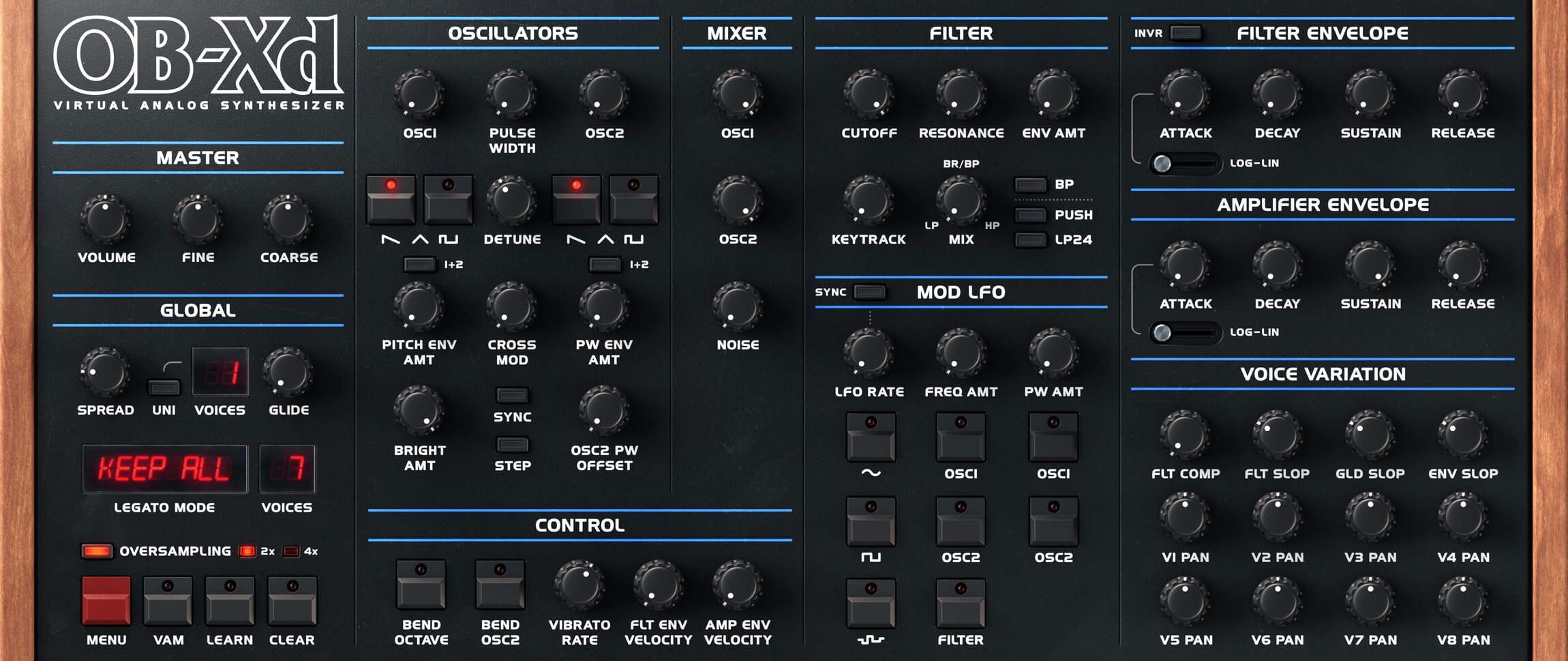
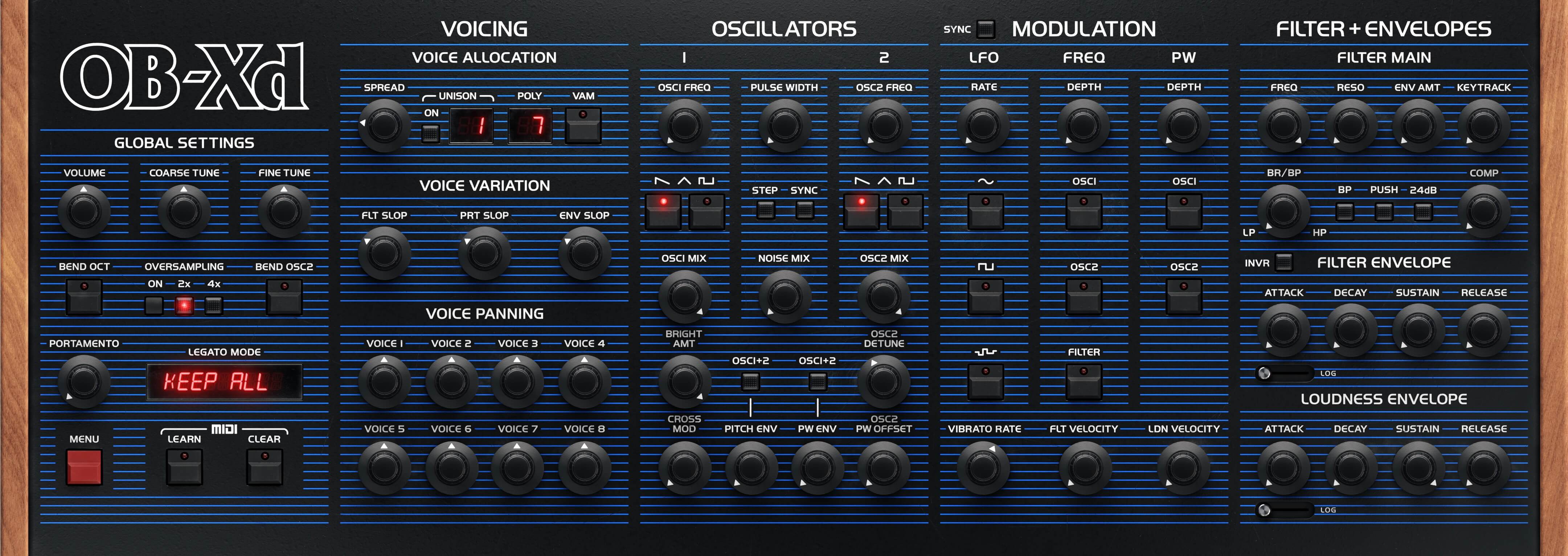
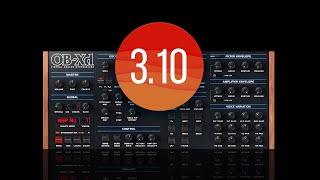
OB-Xd 3 is an emulation of the Oberheim OB-X with the limits of the 1979 hardware taken off. The voice architecture, filter character, and envelope behavior of the original are preserved, but the things that were physically impossible at the time (wide unison stacks, deep modulation, modern tuning systems) are now in reach. Stacks up to 16 voices per note, holds complex chords without voice stealing, and runs efficiently on modern CPUs. Covers vintage bass and pad territory and pushes further into thick supersaw-style textures.
What's New in OB-Xd 3
Rewritten with the original author

OB-Xd 3 is a complete ground-up rewrite of the engine, built hand-in-hand with original author Vadim Filatov. The classic character is intact, the bones underneath are brand new.
The engine moved from per-voice scalar processing to a fully vectorized design, with ~5x lower CPU than 2.x, room for 128 voice slots instead of 32, and the headroom to stack up to 16 detuned voices per note in polyphonic unison, which wasn't possible before. There are also much higher quality oscillators, new analog modeled filters and envelopes, and adaptive oversampling up to 4x for hardware-grade sound without melting your CPU.
The full technical comparison covers the details.
High Quality Oscillators
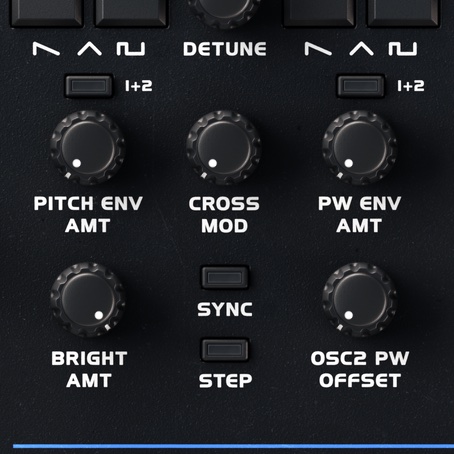
Saws and pulses keep their edge without the digital glass and aliasing that gives away most virtual analogs. Push the upper octaves hard and the top end stays musical, not buzzy. Three pulse-width tools shape the waveform: independent PW offset on Osc2, filter-envelope-driven PW, and dual-osc PW movement.
Improved Analog Modeled Filters
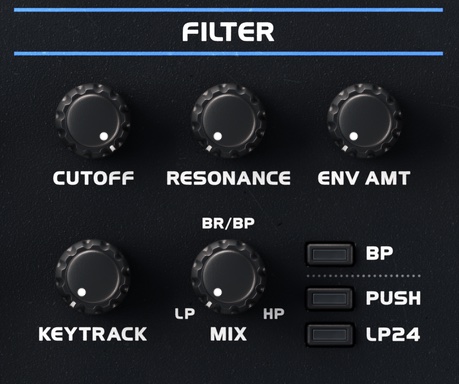
The filter that defined the sound of Van Halen's Jump, Rush's keys, and a thousand '80s anthems, now with the warmth of the original and the precision a modern mix needs. Sweeps sing, resonance bites without going harsh, and self-oscillation gives you a full extra oscillator hiding inside the filter.
Attack envelope shape
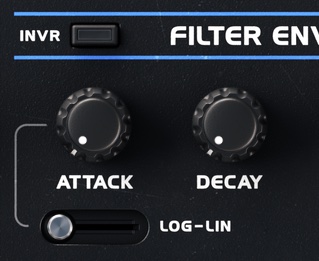
The same RC capacitor curve that gave the OB-X its attack on keys, plucks and percussive leads is now a log-lin slider you can sweep from snappy logarithmic to gentle linear, independently on the filter and amp.
From stab leads to breathing pads: push logarithmic for percussive plucks and aggressive lead attacks, sit in the middle for the classic OB-X punch, dial toward linear for slow swells.
Polyphonic Unison
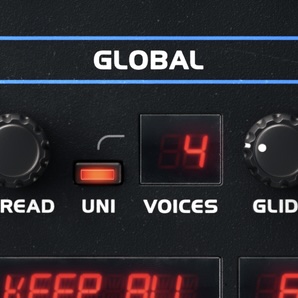
Polyphony 4 with 4 stacked voices = chord-pads with serious weight. Polyphony 1 with 16 stacked voices = supersaw mono leads. Same patch, two completely different instruments.
Unlike most virtual analogs, OB-Xd stacks up to 16 voices per note independently from how many notes you can hold, so you keep your chord polyphony and get the thickness. Push Spread above 50% and the stacked voices read as separate, opening up the stereo field.
MPE
Full MIDI Polyphonic Expression support with independent per-note pitch bend (X), timbre (Y, CC 74) and pressure (Z), each freely routable to multiple destinations. Plug-and-play with LinnStrument, ROLI Seaboard, Sensel Morph, Haken Continuum and more. OB-Xd auto-configures from the controller, and ships with factory presets for every major MPE surface.
Bi-directional MIDI
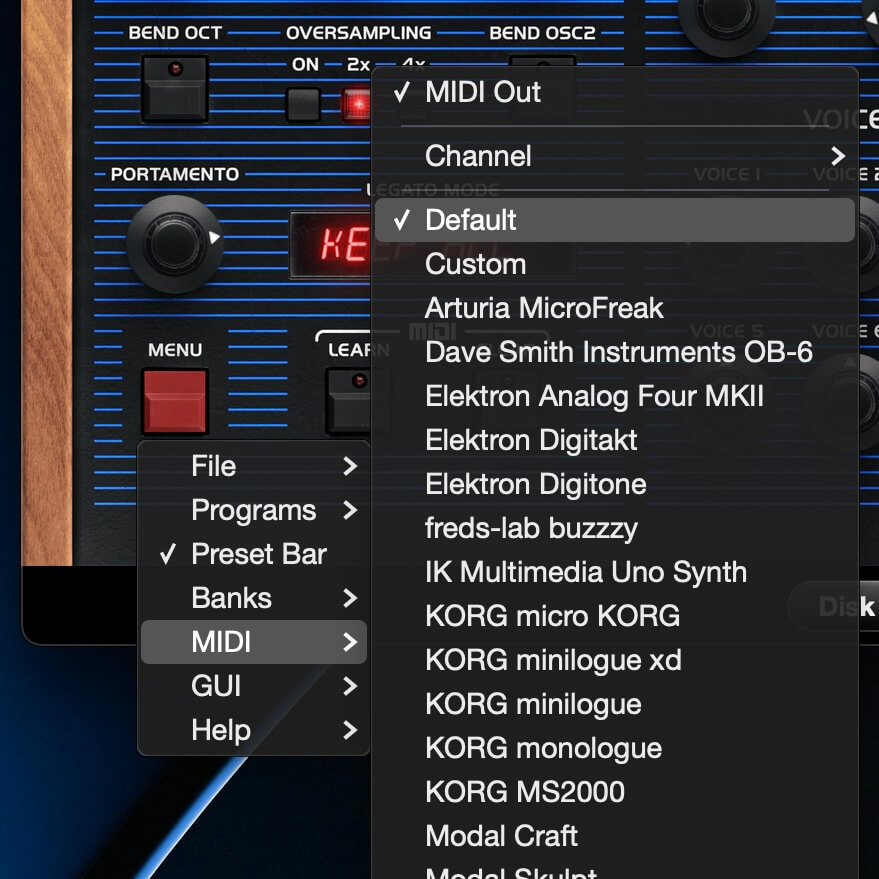
MIDI Out sends CC mirroring on channel 1 (or a selected channel). Pair it with the TouchOSC template or the SFC-OB hardware controller and the surface stays in sync with the plugin.
Preset search
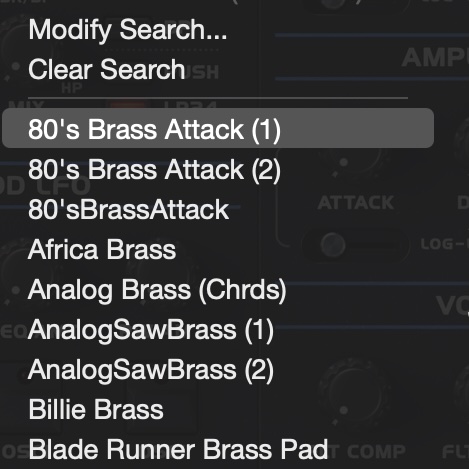
Recursive search across all disk preset folders with duplicate handling: same-named presets show as "(1)", "(2)", etc. Step through results in order.
Oversampling and More

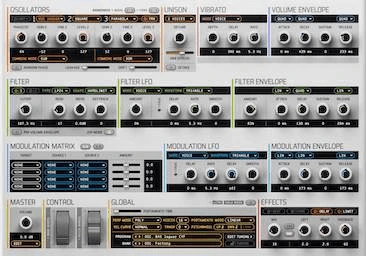
Dual LFOs: two fully independent LFOs running in parallel, each with its own rate, three waveforms, two amount controls, five destinations, and per-LFO tempo sync. Stack a slow filter sweep over a fast vibrato, or sync both to the host for tight rhythmic patches.
Knob LED Visualizer: the interface reflects what the engine is doing as you play. Volume knob shows a true VU meter, the cutoff dot tracks live envelope and LFO modulation, ADSR strips animate during note playback, and any routed destination glows green so you see exactly what your modulation is doing.
Reworked MIDI Learn: live LCD prompts walk you through CC mapping. Save, rename, import or export full MIDI boards grouped by manufacturer, and ship presets with their CC layout intact.
Preset Bar Workflow: anchored Disk Browser, native Save / Rename dialogs, bank search, and shift-click shortcuts for prev/next jumping by bank or folder.
Standalone MIDI Out: virtual CoreMIDI port for routing OB-Xd's MIDI stream to external gear or other apps.
Analog Mode: per-voice component tolerances that bring the subtle detuning and filter wobble of vintage hardware. Stored per bank so different presets can use different amounts.
MTS-ESP Microtuning: full ODDSound MTS-ESP support for scales beyond 12-TET.
Dynamic Pan Presets: Random and Random OSC modes spread voices across the stereo field on every note.
Preset Import: loads OB-Xd 2.x patches and community fork presets directly.
Oversampling: 1x / 2x / 4x in the registered version.
Supported Formats
Universal Binary 2: Native Intel and Apple Silicon.
Standalone Application: No additional software required.
ProTools AAX. Apple Audio Unit. Steinberg VST. Steinberg VST3. LV2.








System Requirements
 Windows 10+. IntelIntel processors with AVX2 support:
 10.14+. Apple Silicon or IntelMacBook Pro: Late 2013+
 Debian 10+. IntelIntel processors with AVX2 support:
 iOS 14 or later.
The free trial version of OB-Xd is fully functional, with no major limitations on its features, but it prohibits commercial use. The term commercial purpose means using the software for any fee, charge, tariff or other consideration directly or indirectly in connection with any commercial or other for-profit enterprise.
Credit and Licensing
OB-Xd is a software synthesizer licensed by Vadim Filatov. All rights reserved.